

Why Grandma Was (Probably) Mentally Healthier Than You
The physical and cultural impact of once ‘working’ for our dopamine rushes.

Have you ever built a model airplane, completed a paint-by-numbers kit, or finished a design on a LiteBrite set?
If you’re Gen X or older, chances are you know exactly what I mean. You opened the box, smelled the glue, slowly lined up every little plastic peg, or you were forced to wait for paint to dry on the paint by number kit so you could paint the next color next to it. You sat for hours, days even. No screens. No rush. Just... process.
Now let me ask you: when was the last time you waited days for satisfaction?
There’s a reason that model plane or paint-by-numbers kit might’ve made you happier than a TikTok binge ever could. Why did most of us, or, almost our entire Gen-X culture, appear happier then? Here’s the insight, it was not just about nostalgic memories.
It’s about neurology.
Let’s look at our current condition.
Today, we’re seeing a rise in mental illness, burnout, and identity confusion at unprecedented levels. Anxiety rates among Gen Z are estimated to be 30 to 40% higher than previous generations at the same age. Depression. Suicide. Brain fog. ADHD. It’s not just cultural it’s biological. So let’s ask the deeper question:
What changed?
And what did model planes and slow crafts give us that we’re missing now?
Rethinking Dopamine
We talk about dopamine like it’s the pleasure molecule.
It’s not.
It’s the molecule of anticipation.
Dopamine fires, not when the reward hits, but when we expect it.
When we build a model, knit a scarf, wait for a letter in the mail, or develop a photograph, our brain is building up dopamine slowly, creating a robust synaptic path. That’s called ‘tonic dopamine:’ a low, steady hum that strengthens our ability to focus, persist, and wait.
But the dopamine of this generation? It’s “phasic dopamine:” sudden, shallow spikes from Instagram likes, YouTube clips, mobile games, and infinite scroll.
No anticipation. No buildup. Just instant hits.
And when that dopamine floods a weaker, less-developed neural path, the brain doesn’t get stronger. It gets more addicted. More depleted. More anxious.
The Lost Art – and Health – of Anticipation
The key difference between tonic and phasic? Time.
Gen-X kids didn’t just fill time. We waited. We anticipated. That built not just self-control but it built literal brain structure.
When you delay gratification, you exercise your prefrontal cortex the part of your brain responsible for judgment, emotional regulation, and goal setting.
A famous Stanford study in the 70s, the Marshmallow Test, found that kids who could wait 15 minutes for a second marshmallow had better life outcomes 30 years later. That test has since been repeated around the world with one consistent finding: anticipation builds success.
And it’s not just about financial success. It’s about mental and physical health.
We now know that repeated engagement in delayed-reward activities like model building, puzzles, or painting leads to:
Better dopaminergic tone
Higher resilience to stress
Decreased risk of depression and anxiety
(Source: Volkow et al., National Institute on Drug Abuse)
We Used to Work for Our Dopamine…
Here’s the simplest way to put it: we used to work for our dopamine. Now we don’t.
Now dopamine just shows up unearned, unstructured, and unsustainable.
That changes the architecture of our brains. It weakens our synaptic plasticity our ability to change and grow. And that means future dopamine hits don’t feel as good. So what do we do?
We chase harder… Scroll longer… Stimulate more…
And, yet, still feel emptier.
That’s the definition of addiction.
A study from the University of Copenhagen found that excessive digital stimulation lowers baseline dopamine receptor sensitivity meaning over time, the same stimulus gives you less joy.
Like overwatering a plant that has no roots.
Why Grandma Was (Probably) Mentally Healthier Than You
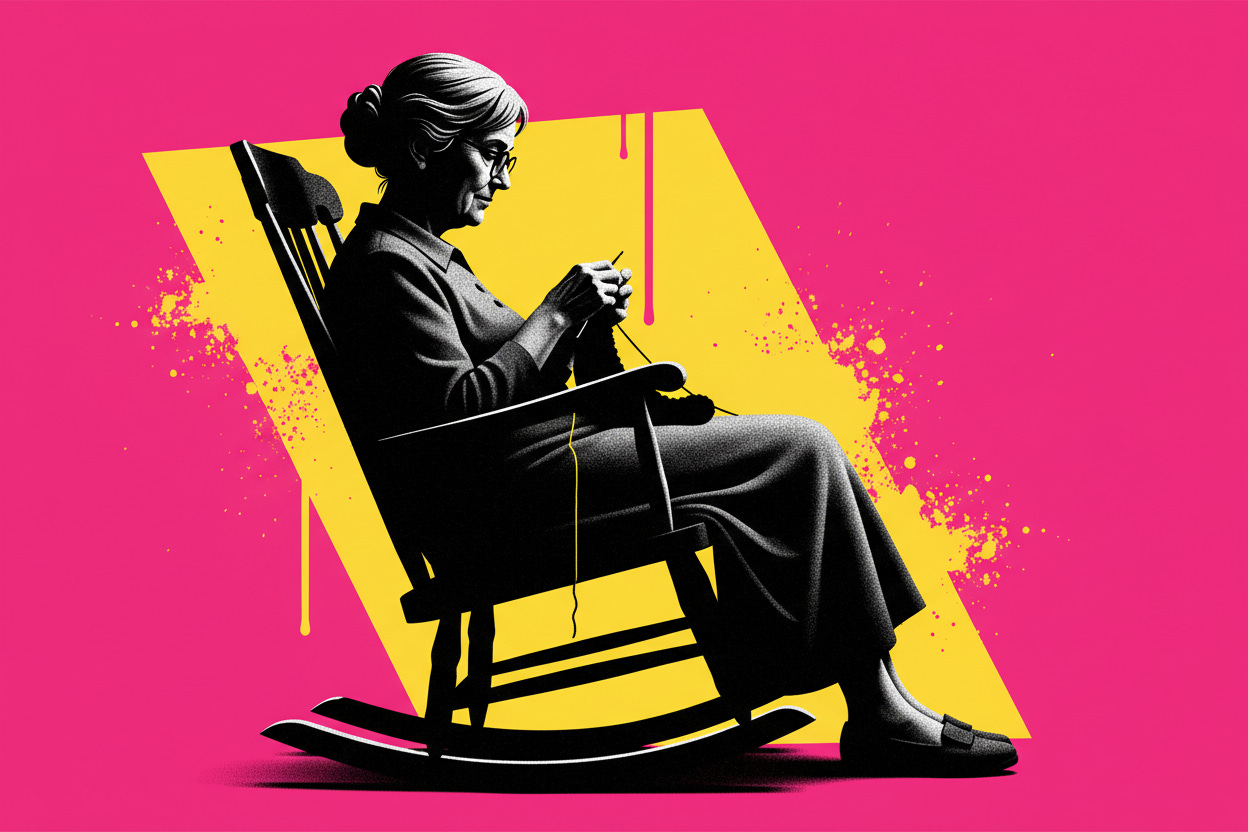
Many of our grandmothers painted, crocheted, gardened. They didn’t just pass time they built resilience.
Those activities:
Took hours or days to finish.
Required fine motor coordination.
Had tangible, rewarding outcomes.
And most importantly they delayed gratification.
This built synaptic robustness a term used in neuroscience to describe the strength and efficiency of neural circuits. Like insulated wires, these thicker synaptic paths made joy more sustainable... and brains more resilient.
The Neurological Cost of a “Now” Generation
Let’s talk about the cost of always-on dopamine.
We now see teenagers unable to go more than 3 minutes without checking a screen. We see dopamine loops hijacked by algorithms designed to trigger novelty, not mastery.
The result?
Emotional dysregulation
Decreased executive function
Reduced capacity for long-term planning
And a sharp increase in social fragmentation and identity confusion
Researchers like Dr. Anna Lembke at Stanford, author of Dopamine Nation, argue that the modern world is experiencing a dopamine crisis, driven by overstimulation and instant access.
And here’s the tragic part: kids today aren’t broken. Their environments are.
We’re not teaching them how to build anticipation anymore. We’re just teaching them how to consume.
The Physical Implications of a Weaker Mind
What if physical sickness isn’t just about what we eat, how we sleep, or even how we move?
What if it begins in the brain not in what we think, but in how our neural structures were (or weren’t) built?
Modern neuroscience is starting to confirm what ancient traditions always sensed: the brain doesn’t just run the mind it regulates the body. And when your neurology is underdeveloped or overstimulated, your physical health starts to erode in subtle, systemic ways.
Let’s break it down.
Weak Neural Pathways = Weak Body Regulation
Every voluntary and involuntary process in your body breathing, digestion, hormonal balance, immunity, even posture is governed by your nervous system.
And your nervous system, at its core, is an electrical grid of neurons, synapses, and pathways.
When those synaptic connections are:
Underdeveloped (due to overstimulation, digital speed, and lack of challenge)
Poorly myelinated (no repetitive, time-based tasks to thicken those pathways)
Not reinforced through physical, sensory, and time-based learning…
Then your body’s internal systems don’t just become chaotic…
… they become fragile.
Think about it this way:
If your wiring is thin, then your circuit board can’t handle life’s voltage.
The Model Isn’t the Plane, It’s the Brain
That model airplane you built when you were 12?
It wasn’t about the plane. It was about the pattern.
The neurological pattern.
Slow, intentional tasks built THICK synaptic wiring. That wiring supported mental health, resilience, focus, and even empathy.
And if we want to rebuild the mental and emotional scaffolding of the next generation, we need to return to the neuroscience of slowness.
Not as punishment.
As protection.
Dopamine isn’t bad. Instant gratification isn’t evil.
But if we want our kids to have lasting joy, not just stimulus, we have to teach them how to earn it.
Not with lectures. With LEGOs. With puzzles. With paint. With paper. With waiting.
We don’t need nostalgia. We need neuroplasticity.
And it starts with understanding that every time we waited, worked, or wondered
We weren’t just killing time.
We were wiring hope and health into our brains.
So what do we do?
If you’re wondering how to fight back against the chaos of overstimulation, if you want to build a stronger brain for yourself or for the next generation here are three science-backed, instantly-applicable steps:
1. Practice “Slow Dopamine” Once a Day
Choose one activity that takes at least 30 minutes to complete and has no shortcut.
Read a physical book. Journal. Paint. Do a puzzle. Whittle wood. Crochet. Build something. Whatever it is, don’t rush. The key is to earn the dopamine at the end not chase it at the start.
Neuroscientists call this building tonic dopaminergic tone, which has been shown to:
Improve long-term motivation
Regulate emotional reactivity
Increase baseline joy
(Source: Dr. Anna Lembke, Stanford University)
2. Delay Gratification Intentionally
Every day, find one thing you want and wait 10 minutes before indulging.
It sounds small, but this trains your prefrontal cortex to reassert control over impulse. It rebalances your reward system. You’re not denying yourself. You’re retraining your brain to crave more deeply, more richly, and more sustainably.
This same technique is used in dopamine detox therapy for tech addiction and mood disorders.
(Reference: Dr. Cameron Sepah, UC San Francisco)
3. Replace Passive Scroll with Active Creation
Instead of watching 20 TikToks or scrolling through 80 reels, take 10 of those minutes and create something.
Write a song lyric. Sketch. Record a voice note of your thoughts. Take photos of shadows. Build something with your hands. Teach your kid how to make something from scratch.
Creation fires a totally different neural network than consumption.
It activates your default mode network and improves cognitive integration your brain’s ability to connect unrelated ideas and solve real-world problems.
(*Source: Raichle et al., Trends in Cognitive Sciences)
None of this is about going back in time. It’s about going forward with intention.
This is not about nostalgia for model planes or cassette tapes. It’s about recognizing that the human brain was built for anticipation, for challenge, for earned satisfaction not for endless dopamine drip feeds.
And it’s about reclaiming our neurobiology, before someone else programs it for us.
You don’t need a new prescription. You need an old hobby.
Pick up the model kit. Wait for the paint to dry. Let time stretch again.
Because you’re not just killing time, you’re rebuilding the pathways that help you love, focus, and thrive.
Then go spend some time with Grandma… and just listen.
Brillant framing of the tonic vs phasic dopamine distinction. The insight about synaptic robustness being built through time-based tasks really clarifies why baseline dopamine sensitivity drops with overstimulation. I dunno if folks realize that the "wiring thickness" metaphor isnt just poetic but actually maps to myelination. Makes me think weactually need friction in our daily routines, not smoother tech.
Wow, what an interesting take! 🙌
I totally resonate with your intro about how AI helps connect the dots. I also feel like it's helping me evolve from an overwhelmed generalist into a high-impact polymath.
Your core idea about delayed gratification is spot-on, too. I catch myself getting impatient when a website takes more than three seconds to load. For me, though, it wasn't model kits back in the day, but Lego. The interesting thing was, it was always about the building and the sorting. Once the model was finished and it was time to "play" with it, I lost interest, much to the confusion of my friends.
I'm sure part of it is just my disposition, but I also believe, as you described, that it rewired my brain and led me to where I am today – writing. Reading and writing didn't appeal to me at first because I lacked the maturity to create complex organizational structures in my writing. But now, when I write, I feel like I'm sorting the "Lego bricks of knowledge." I actually wrote an article about this very connection a few weeks ago after figuring it out. It's in German, so you'd need a translator if you were curious (https://simonrichartz.substack.com/p/wie-du-deine-kindheits-starke-in)
I'm already looking forward to when my son is old enough for Lego so I can build with him. Until then, maybe I'll grab a puzzle or something. Thanks for sharing, this is really thought-provoking!