

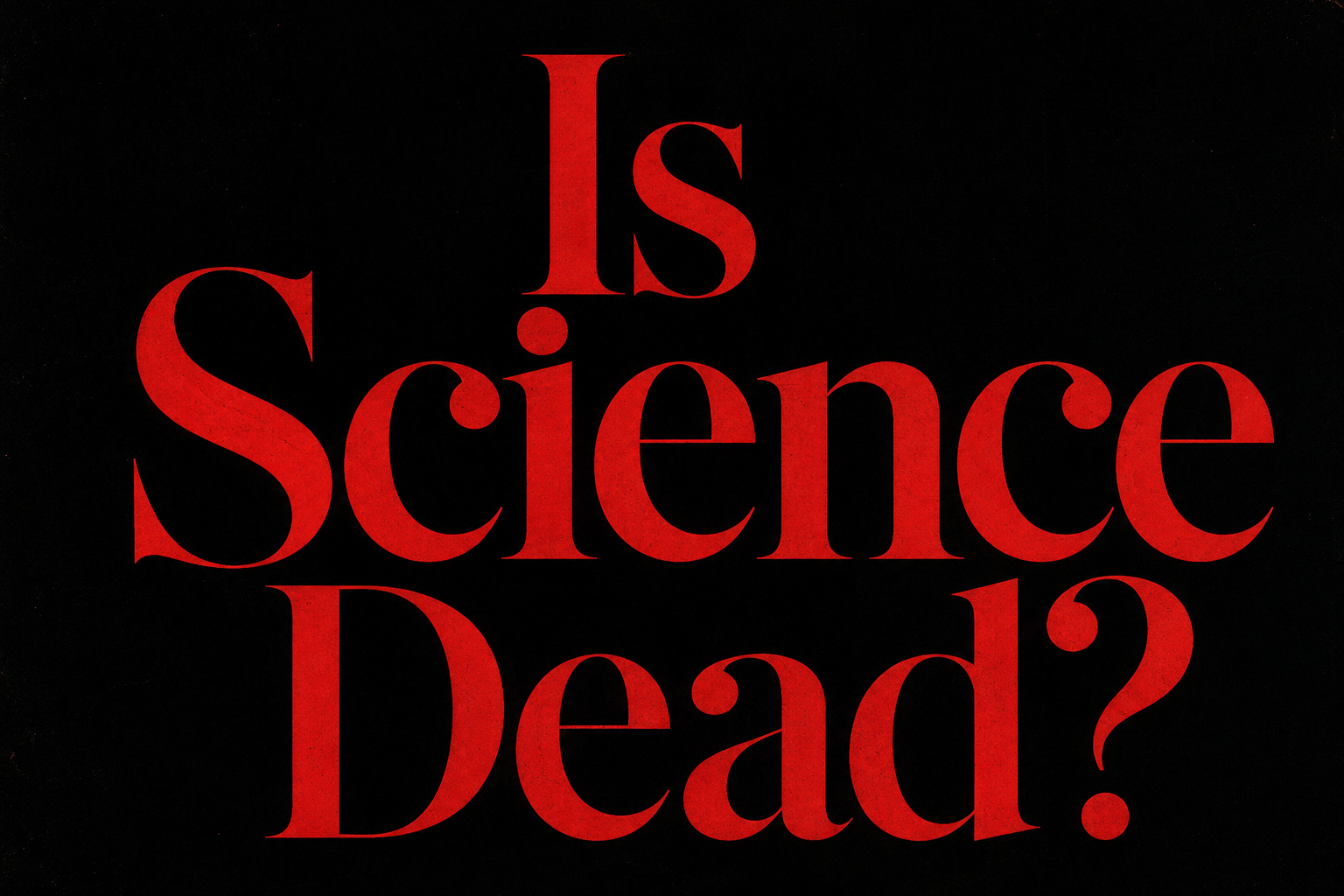
IS SCIENCE DEAD?
Not as observation—but as universal explanation?

On April 8, 1966—two days before Easter—TIME magazine published one of the most provocative covers in its history.
There was no photograph.
No illustration.
No scientist, theologian, priest, or protester.
Only three red words against a field of black:
IS GOD DEAD?
It was the first cover in TIME’s 43-year history to use only text. The editors understood something about language: sometimes a question is powerful enough to become the image.
But the article behind the cover was more nuanced than the cultural memory of it.
TIME was not simply announcing the death of God. It was examining a small group of radical theologians attempting something almost unimaginable: preserving Christian ethics and language after concluding that the traditional conception of God was no longer intellectually credible or culturally present.
They were attempting a theology without theos.
The deeper question was not merely whether God existed. It was whether modern humanity—with its science, technology, suffering, secularism, and increasing confidence in material explanation—had any further need for God.
Nearly sixty years later, perhaps it is time to reverse the cover.
IS SCIENCE DEAD?
Not because science has failed.
Because it has succeeded beyond anything the writers of that 1966 article could have imagined.
Science can now watch nicotine recruit the reward system. It can observe trauma continuing inside the body after danger has passed. It can map genetic regulation, neural plasticity, ecological interdependence, cellular repair, hormonal communication, and the biological consequences of isolation.
The farther science looks, the less reality resembles disconnected machinery.
And the more it looks like architecture.
So, again:
IS SCIENCE DEAD?
Not science as observation.
Not science as experiment.
Not science as medicine, measurement, or disciplined inquiry.
But science as universal explanation.
Something strange happened after TIME asked whether God was dead.
Science kept looking.
And the farther it looked, the more intention seemed to appear.
Science Did Not Kill God
Science is one of humanity’s most extraordinary achievements. It teaches us to observe carefully, test claims, measure outcomes, revise assumptions, and distinguish what we hope is true from what the evidence permits us to say.
That kind of science is not dead.
It is indispensable.
But science gradually became more than a method. It became a metaphysics.
A discipline designed to investigate measurable processes was promoted into a philosophy capable of declaring what reality ultimately is, what human beings mean, and whether purpose exists.
That is not science.
That is scientism: the belief that whatever cannot be measured is either unreal, irrelevant, or eventually reducible to something that can be.
Science can describe the electrical activity associated with love. Scientism concludes that love is nothing more than electrical activity.
Science can identify neural activity associated with awe. Scientism concludes that awe is merely neurons firing.
Science can explain mechanisms of attachment, reproduction, healing, and adaptation. Scientism assumes that explaining the mechanism has eliminated the possibility of meaning.
But a map of the machinery is not a verdict on why the machinery exists.
And scientism may now be dying beneath the weight of science’s own discoveries—not because we know less than before, but because we know more than ever.
Science Is the Study of Reaction
At its heart, science studies relationships between action and reaction.
What happens when we introduce this chemical? Remove this organism? Repeat this behavior? Interrupt this relationship? Increase this stimulus? Change this environment?
For most of human history, the interval between action and observable reaction was enormous.
A person smoked for decades before the tumor appeared. A child endured years of instability before adult symptoms became recognizable. A forest was stripped gradually before the watershed collapsed. A culture trained itself toward endless stimulation long before the deterioration of attention, intimacy, and mental health became measurable.
The reaction arrived so long after the action that we could pretend the two were unrelated.
But our instruments are shortening the distance.
We can now observe physiological changes in minutes, receptor activity, altered patterns of attention, stress responses, reward learning, hormonal shifts, neural adaptation, and changes in gene expression.
Science once had to wait for the funeral to recognize the danger.
Now it can watch the system begin adapting almost immediately.
We once knew smoking was harmful because people eventually became sick. Now we understand far more about nicotine’s rapid interaction with receptors, reward pathways, attention, conditioning, and dependence.
Smoking is not merely “bad for you” thirty years later.
It begins negotiating with the nervous system now.
The product is not simply delivering pleasure. It is recruiting architecture. It is teaching the brain to associate relief, stimulation, identity, environment, ritual, and repetition with the substance altering it.
Smoking is neurologically and biologically strategic—not because the cigarette is conscious, but because its delivery system is remarkably effective at exploiting a living system’s ability to learn.
The shorter the distance between action and reaction becomes, the harder it is to dismiss the reaction as meaningless.
The body is not merely responding.
It may be revealing.
The Body Is Not Simply You
We speak about the body as though it were property.
“Don’t tell me what to do with my body.”
As if the conscious self were the owner and the body were an obedient vehicle awaiting instructions.
But your body is not identical to the conscious “you.” It is a living system with its own regulatory priorities, thresholds, alarms, memories, compensations, and survival strategies.
You can tell yourself everything is fine while your nervous system disagrees. You can decide an environment is safe while your heart rate, digestion, muscle tension, sleep, immunity, and vigilance behave as though danger remains. You can consciously forgive an event while your body still braces for its return.
The body does not require your philosophical agreement before responding.
It is not a separate person, but it possesses a profound degree of regulatory independence from conscious permission.
Your mind experiences an event.
Your body calculates its total cost.
That distinction becomes especially visible after childbirth.
A mother may consciously experience love, gratitude, wonder, and joy while her body is simultaneously negotiating hormonal upheaval, physical recovery, interrupted sleep, immune changes, feeding demands, threat sensitivity, attachment reorganization, and the sudden responsibility of keeping another human alive.
Postpartum depression is complex. It cannot be reduced to one cause or interpreted as one simple biological message. Genetics, prior mental health, hormonal changes, sleep disruption, trauma, stress, isolation, and social conditions may all play a role.
But it reveals something our culture often resists:
The body does not ask whether an experience is socially celebrated. It asks whether the whole system can now carry it.
The conscious story may say, “This is the happiest moment of your life.”
The body may answer, “I am overloaded.”
Science then develops therapy, medication, support systems, and clinical language around the response. That is merciful and necessary.
But beneath the treatment is a deeper revelation: the human being is not a mind floating above biology. We are integrated systems, and the system speaks even when the conscious self does not understand the language.
“Side Effects” Are Often System Effects
Few phrases expose the limitations of isolated thinking more clearly than:
Side effects may include…
Modern medicine has relieved extraordinary suffering. Surgery, antibiotics, imaging, anesthesia, trauma care, vaccines, and pharmaceutical treatments have saved lives on a scale earlier generations could scarcely imagine.
But nearly every intervention carries a quiet confession:
The body is connected.
A medication may be designed to alter one pathway, receptor, hormone, blood vessel, inflammatory process, or signaling system. But that same pathway may also participate in sexual function, mood, digestion, sleep, cognition, circulation, immunity, or energy regulation.
Medicine calls an unwanted result a side effect because it occurred outside the intended target.
The body may call it a system effect because nothing inside you is truly outside anything else.
Not every adverse effect is the body attacking a foreign threat. Some are immune responses. Others occur because the same biological machinery serves several functions at once. Still others arise because changing one part of an interconnected system changes the conditions surrounding many others.
But the larger truth remains:
A side effect may simply be the rest of the body refusing to remain outside the experiment.
The treatment says, “I came for this one mechanism.”
The body answers, “There is no such thing as only one mechanism.”
This is not evidence that medicine is fraudulent. It is evidence that the body possesses an architecture more integrated than any isolated intervention can fully anticipate.
Science is extraordinarily effective at isolating variables.
Life refuses to stay isolated.
The More We Discover, the More Intention Appears
A cut is not treated by the body as a neutral rearrangement of matter.
Blood vessels constrict. Platelets gather. Immune cells arrive. Damaged material is removed. New tissue begins filling the breach.
The body behaves as though a wound is a departure from a preferable condition.
It distinguishes fracture from integrity.
The immune system distinguishes self from threat. The nervous system distinguishes safety from danger. Cells regulate internal conditions. Damaged DNA may be repaired. Neural networks can reorganize after injury. Ecosystems can regenerate—or collapse when critical relationships are severed.
Science describes these mechanisms brilliantly.
But the mechanisms increasingly reveal what science once trained us not to see:
Reality behaves as though outcomes matter.
The body does not merely change; it corrects. Life does not merely exist; it preserves the conditions under which existence can continue.
Ecology does not reveal isolated organisms competing in empty space. It reveals exchange, dependence, reciprocity, communication, succession, regeneration, and consequence.
Genetics did not uncover a simple mechanical script. It uncovered regulation, signaling, suppression, activation, repair, inheritance, responsiveness, and environmental influence operating across staggering levels of coordination.
Neuroscience did not reveal fixed wiring.
It revealed plasticity.
The brain is shaped by what it repeatedly encounters, attends to, fears, desires, practices, and loves.
Those that understand epigenetics, understand that you can even influence future genetic reproduction through certain repeated activities.
The deeper science travels into reality, the more it encounters architecture:
Not merely parts, but relationships.
Not merely matter, but information.
Not merely survival, but recurring conditions under which life coheres or fractures.
Science did not disprove intention.
It kept uncovering its fingerprints.
Johnny Was Told There Was No Purpose
In the song I wrote, LOST GOD AS CREATOR, Johnny sits in a classroom and absorbs an idea he cannot yet fully articulate:
In the walls of a classroom
Johnny sits to hear
At the center of existence
There’s no purpose made clear
He may learn accurate evolutionary facts about atoms, reproduction, adaptation, heredity, and natural selection.
But beneath the lesson often sits another conclusion—one rarely identified as philosophy because it arrives dressed as science:
You are here by accident.
Your desires are chemical events.
Love is reproductive strategy.
Consciousness is neural activity.
Meaning is something you manufacture to tolerate a universe that possesses none.
Johnny cannot debate that worldview.
But he can feel its consequences. The last four lines of the verse:
Though he can’t fully grasp it
Its effects are felt later
ANYTHING TO FILL THE VOID
When you lose God as Creator.
If there is no intended destination, anything capable of filling the void can become a substitute compass:
Achievement. Pornography. Consumption. Status. Tribal identity. Chemical escape. Digital attention.
Anything to fill the void when we lose God as Creator.
Science did not necessarily teach Johnny those conclusions. But a culture using science as universal explanation often did.
It confused the ability to describe the machinery with the authority to deny the meaning of the machine.
“We Don’t Need to Find Reason”
Jack Johnson sings:
“We don’t need to find reason…”
That fragment captures the modern posture perfectly.
Do not ask too deeply.
Do not ask where desire came from, what consciousness is for, why beauty moves us, why betrayal wounds us, why isolation harms us, or why the body keeps attempting to return to health.
Let the question leave through the same door it entered.
But the questions have not left.
They have multiplied.
the next section of the Jack’s verse is even more powerful.
“We don’t need to find reason, because out the same door that it came, well it’s leaving, it’s leaving.”
Why does attachment regulate the nervous system? Why does prolonged isolation enter the body? Why does trauma alter perception long after danger is gone? Why do belonging, purpose, touch, movement, nourishment, sleep, and relationship influence measurable health?
Why do human systems repeatedly deteriorate when appetite becomes detached from proportion, sexuality from relationship, economics from ecology, power from responsibility, or technology from consequence?
Science can observe the pattern.
But when someone asks whether that pattern reveals anything about how human beings are meant to live, science suddenly becomes shy, even not awkwardly silent.
It will describe coherence everywhere except where coherence begins to resemble intent.
We Live in the Days of Revelation
We live in the days of Revelation.
Sorry, fundamentalists.
I am not talking about eschatology.
I am talking about something far more immediate.
We are living through an unveiling.
Our instruments are pulling back layers that previous generations could not see:
Genetics reveals regulation.
Neuroscience reveals plasticity.
Trauma research reveals embodied memory.
Ecology reveals interdependence.
Medicine reveals integration.
Imaging reveals the body responding before outward consequences become visible.
Science once observed outcomes.
Then it began observing mechanisms.
Now it is beginning to expose architecture.
And architecture raises questions that mechanism alone cannot answer.
Why does the system resist? Why does it compensate? Why does it repair? Why does one intervention echo through the whole? Why does repeated stimulation reorganize desire? Why does the body remember what the mind would rather forget? Why does ecology punish extraction?
Why does the organism continually respond as though some conditions support life while others violate it?
Discovery becomes revelation when the mechanism begins disclosing the meaning of the system.
Science is not dead because it stopped discovering.
Scientism is dead as universal explanation because its discoveries have become too meaningful for its old philosophy.
Is Science Dead?
Observation is not dead. Experimentation is not dead. Medicine is not dead. Physics, biology, neuroscience, genetics, and ecology are not dead.
What may be dying is the fantasy that science can become a complete metaphysics without ceasing to be science.
Science can tell us what happens when we violate the architecture of a system. It cannot, through measurement alone, tell us why that architecture exists.
It can map the mechanisms of attachment. It cannot reduce love to those mechanisms without losing the very thing it set out to explain.
It can identify neural activity associated with awe. It cannot prove awe is nothing but neural activity.
It can describe the body’s movement toward repair. It cannot forbid us from asking why reality contains repair at all.
Perhaps God was never displaced by science.
Perhaps the god that died as claimed in 1966 was only the smaller one we used to explain the gaps in our ability to process knowledge.
And perhaps what is emerging now is far more disruptive:
Not a God hiding where science has not yet looked—
but a Blueprint becoming visible because science is growing ever more observant.
In Conclusion
In 1966, TIME asked whether modern knowledge had made God unnecessary.
Nearly sixty years later, modern knowledge may be revealing how premature that question was.
Science was once powerful enough to describe the world. Why? Because our technologies were limiting enough. But now those technologies are becoming so precise that they are revealing what the world has always been trying to tell us.
Yes, we live in the days of revelation—
not because the sky is opening,
but because the systems are.
Scientism only works when we avoid what our advancing scientific technologies are now revealing. It survives by refusing to follow science all the way to its own implications.
To answer the question in the title: no, science is not dead.
But scientism can now be revealed not as deceased but as dangerous; not because it refuses to observe, but because what it refuses to recognize has become an engine of fracture:
Training appetites against the body
Technologies against the person
Economies against ecology
and progress against human flourishing itself.
Instead, God’s love for the human being—and for the attached human organism—is constantly being displayed:
In every warning signal.
Every repair response.
Every adaptation.
Every consequence.
Every movement back toward coherence.
Science did not bury God.
It kept uncovering the architecture of His care.
While that may sound like theology, it also now sounds like science.
And it opens the world again to wonder.
If science’s gatekeepers can apply the same rigorous skepticism to their own dogma…wait, isn’t that precisely what science has long accused religion of failing to do?
My, how times have changed.
Don’t just take my word for it. Here’s the Deep Dive podcast discussing this article.
"As if the conscious self were the owner and the body were an obedient vehicle awaiting instructions." You are right, David; that happens a lot, and even has a name: "Intuitive dualism bias", and it's very much what you're talking about: the person feels that their head is like a cockpit that they inhabit as a separate entity from the body (hence the name "dualism"), and they give orders to THEIR body.